Bigbury Community Wind
A community-owned wind turbine for cleaner energy and local benefit.
Working across Bigbury, Ringmore, Kingston and Aveton Gifford.
Bigbury Community Wind Turbine
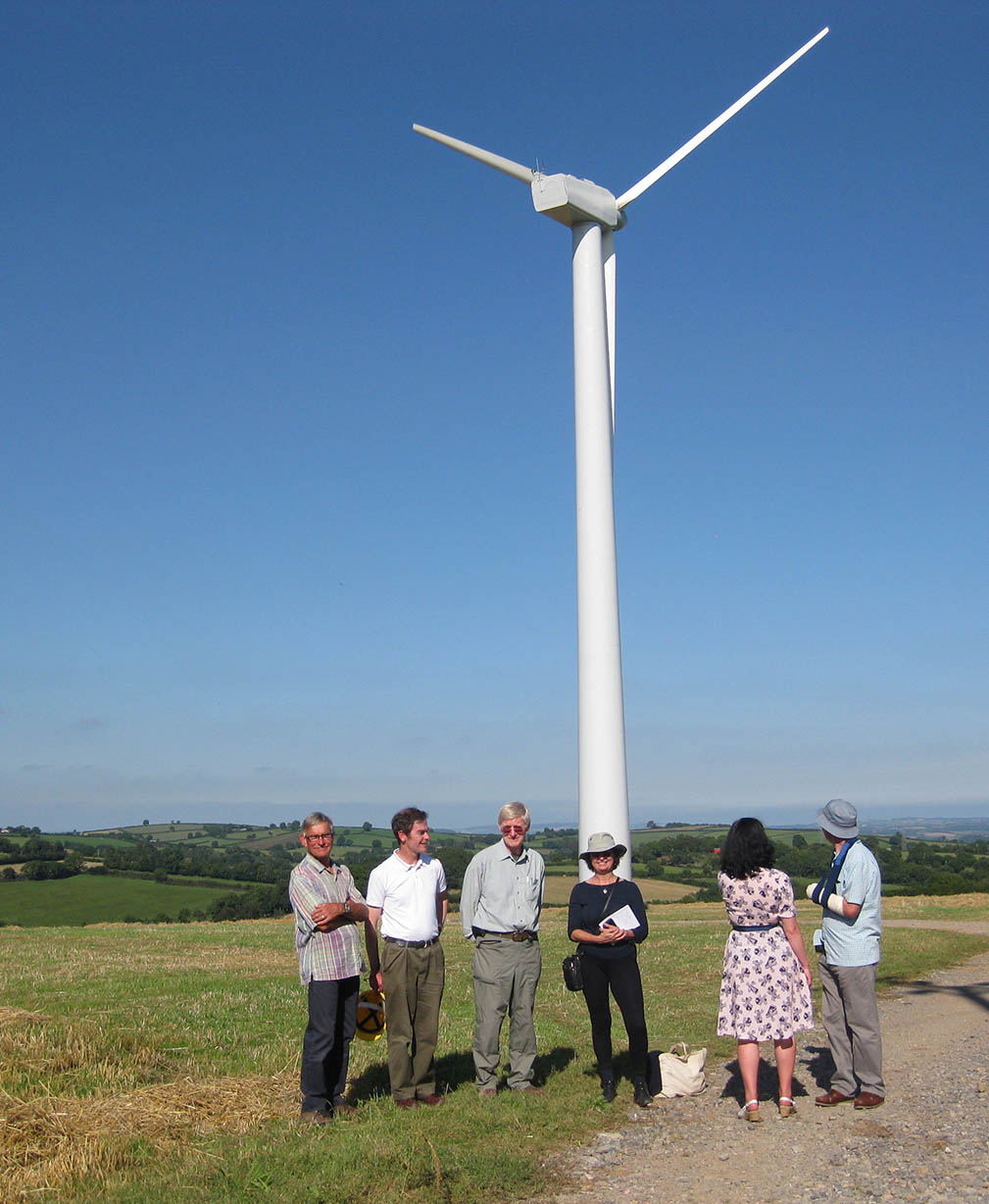
Devon Energy Collective CIC are collaborating with Bigbury Net Zero, a local community action group in South Devon, to explore renewable energy alternatives for the Parish. Seeking to decrease its heavy reliance on oil, the partnership identified the site as a viable location for a mid-scale wind turbine. The proposal is for a 1MW wind turbine positioned high up on the hillside of an organic dairy farm where it would generate enough clean renewables to supply the electricity needs of 1,000 homes - almost matching the power consumption of the surrounding parishes of Bigbury, Ringmore, Kingston & Aveton Gifford. The turbine that we are proposing is a single EWT DW61 or equivalent from the Netherlands. Currently this is the smallest commercial turbine available. It has a hub height of just under 60m and a tip height of 90m.
The wind turbine will be owned by the community and operated for the benefit of the community. This means that the surplus revenues from the sales of electricity will be distributed within the local area whilst providing a return on investment for those wishing to become members of the scheme.
A wind turbine at Bigbury would enable the area to become part of an emerging energy system gaining momentum all over the UK, where mid-scale producers provide dispersed and secure renewable energy whilst catering for local needs and being responsive to the communities they serve.
Why Here?
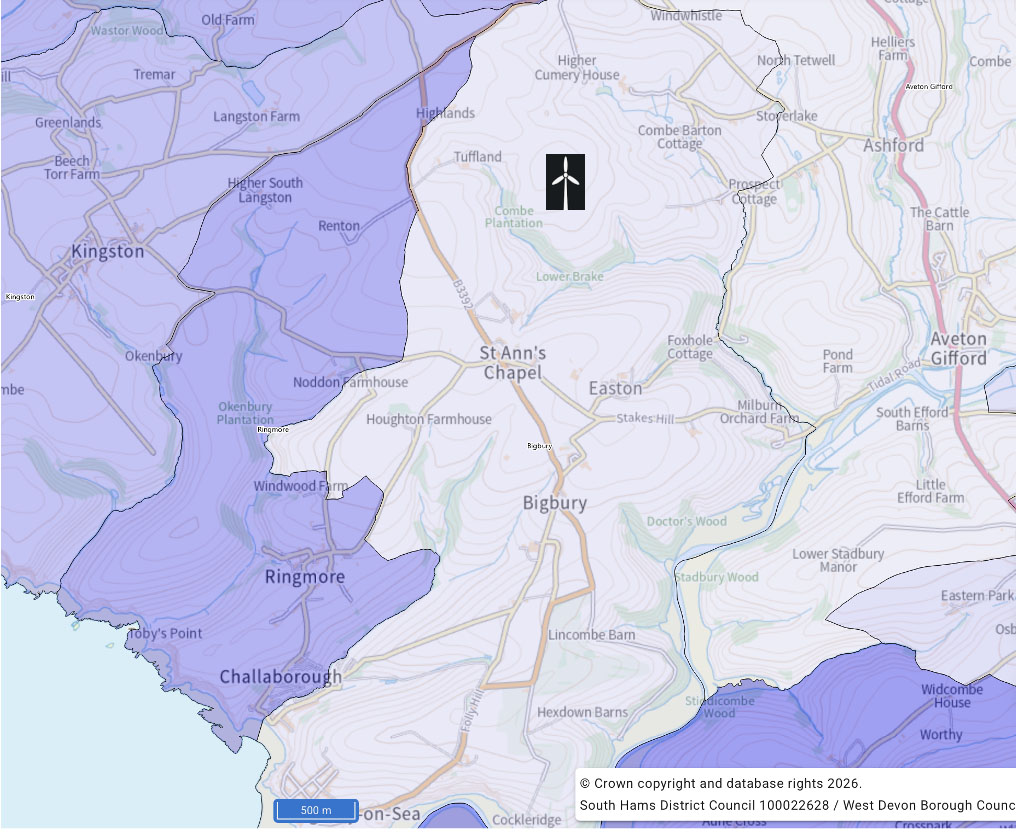
Finding a site for a wind turbine is not easy and there are only a handful of opportunities in the South Hams. This site is suitable for a single turbine because as well as being windy, it has a simple grid connection into the existing overhead wooden poles that distribute the power around the parishes and is a good distance away from homes, infrastructure and important habitats.
Environmental Impact
We are preparing a planning application to submit to South Hams District Council in Autumn 2026. This will include the results of surveys and assessments that will highlight any likely adverse impacts and detail how these impacts will be mitigated.
The Benefits
- Clean, secure, cheap, local electricity generation. With the high wind speeds on site, we expect to see an annual generation of 2,800 MWh of electricity which is enough for approximately 1,000 average UK homes.
- Built, owned and operated by the community for the benefit of the community.
- A commitment to plough financial surpluses back into the community, estimated to be worth £1.5m over the 30 year life of the project.
• An opportunity for local people to invest in the scheme and receive a fair return.
Your views
We would like to hear from you with your views, comments and suggestions.
Community Questions
The Project and Proposal
What is Powering Bigbury Together?
Powering Bigbury Together is the public campaign for a proposal to develop one community-owned wind turbine in the Bigbury area. The current concept is a turbine of about 1 megawatt (MW), expected to generate electricity over a year equivalent to the annual use of around 1000 homes. The electricity would enter the local distribution network rather than being wired directly to particular houses. The intention is that the turbine is owned for community benefit and that, once operating costs and finance are covered, surplus income is retained locally for agreed community priorities. It is not a wind farm and it is not yet an approved development: the project must complete its technical, environmental, financial and planning work before it can proceed.
How can I stay informed and ask questions?
The main source of project information is the Bigbury Net Zero website, including its Power Bigbury page. Updates are also shared through Bigbury Net Zero’s Facebook and Instagram channels, local newsletters such as Bigbury Drums, noticeboards, public meetings and project events. Residents can contact Bigbury Net Zero through the website to submit questions or offer help. A visit to a comparable turbine near Otterham has also been publicised for 12 September 2026. When a planning application is submitted, the definitive drawings and assessments will be available through South Hams District Council’s planning portal, where residents can make formal comments. This FAQ should be updated whenever a material fact changes.
Why is the project being proposed?
The project is being proposed for three connected reasons: to generate more renewable electricity, to make the local energy system more resilient, and to create an asset whose long-term value stays within the community. Bigbury has a strong wind resource and an unusual opportunity to connect one turbine to the local electricity network. The area also relies heavily on oil and LPG for heating because many properties are not connected to mains gas. A wind turbine would not remove that reliance by itself or directly cut every household bill, but it could support the wider move towards electric heating and transport while generating income for locally agreed priorities. The project must still prove that these benefits outweigh its costs and impacts.
Why now?
The project is moving now because suitable grid connections are scarce, the Bigbury proposal has an existing connection agreement, and government funding has been awarded to take the scheme through its development work towards a planning application. The project website gives a target of submitting to South Hams District Council by the end of October 2026. Previous site work carried out by Octopus Energy has also been made available to the community project, providing a head start. These factors create a real opportunity, but not a reason to rush past unanswered questions: the connection terms, surveys, business case and planning documents must all be strong enough to withstand scrutiny.
Who is behind the project?
Powering Bigbury Together is a collaboration between Bigbury Net Zero and Devon Energy Collective CIC. Bigbury Net Zero is the local volunteer-led environmental group providing community leadership, local knowledge and engagement. Devon Energy Collective is the not-for-profit community energy company leading the technical development work. It is a Devon-wide Community Interest Company founded and owned by a network of local community-energy enterprises. The Great British Energy Community Energy Fund award is held through Devon Energy Collective for development of the 1 MW Bigbury turbine. South Hams District Council is not the developer: as the local planning authority, it would independently consider any future planning application.
Has anything been decided yet?
Some important elements are established, but the turbine has not been approved or finally commissioned. The project partners, the intention of community ownership, the broad scale of one 1 MW turbine, the proposed area and the government-backed development funding are all public. A grid connection agreement also exists. What has not been decided is whether the turbine will receive planning permission, whether the final technical and environmental evidence supports construction, precisely which turbine and dimensions will be submitted, how the project will be financed, and how ownership and community benefit will work in practice. Residents will still be able to examine and comment on the formal planning application.
Why only one turbine?
The proposal is for one turbine because the project team says the local electricity network has enough available connection capacity for a single machine of this scale, not a wind farm. A 1 MW turbine can still produce a substantial amount of electricity—currently estimated as the annual equivalent of around 1000 homes—while keeping the physical development to one tower, one foundation and one grid connection. Building more turbines would require more grid capacity and a different, larger planning and environmental case. The ‘one turbine’ limit should nevertheless be supported by the connection agreement and technical documents when these can be published
Why this site?
The proposed site has been identified because several essential factors appear to come together there: a robust & strong wind resource, access to a rare grid connection, sufficient separation from homes, a good distance from infrastructure, a willing land arrangement and a location that can be investigated for construction access and environmental impact. As a guideline, a turbine of this scale & type typically needs to be around 500 metres from homes to avoid unacceptable noise effects. The proposed turbine is about 600 metres from the nearest habitation. Those are important starting points, not a complete assessment. The site must still pass detailed tests covering landscape, ecology, birds and bats, noise, shadow flicker, highways, ground conditions, heritage, aviation and telecommunications.
How big would it be?
The turbine currently being discussed is a 1 MW EWT DW61-type machine with a rotor diameter of about 61 metres and a hub height of up to 59 metres giving a maximum blade-tip height of 90 metres. In simple terms, the hub is the centre of the rotor; the tip height is the highest point reached by a blade. The scale will be shown through dimensioned drawings, maps, viewpoint photography and photomontages so that residents and the planning authority can judge it in its real landscape context.
How much electricity could it generate?
Studies show that the site is likely to export approximately 2,800 MWh of electricity into the local grid each year. A typical UK household uses 2,500 kWh which means that a wind turbine at Bigbury will generate enough power for more than 1,000 average UK homes.
What happens next?
The immediate task is to complete the project-development work needed for a planning application. That includes confirming the turbine and site design, reviewing earlier studies, completing or updating environmental and technical surveys, producing noise and visual assessments, agreeing grid and access arrangements, testing the financial model and continuing community engagement. Once an application is validated in planning, it will be published by the council and residents will be able to comment. Planning permission, if granted, would still be followed by financing, final ownership arrangements, procurement, construction planning and a final investment decision before anything is built.
Community Ownership and Environment
How can I stay informed and ask questions?
The main source of project information is the Bigbury Net Zero website, including its Power Bigbury page. Updates are also shared through Bigbury Net Zero’s Facebook and Instagram channels, local newsletters such as Bigbury Drums, noticeboards, public meetings and project events. Residents can contact Bigbury Net Zero through the website to submit questions or offer help. A visit to a comparable turbine near Otterham has also been publicised for 12 September 2026. When a planning application is submitted, the definitive drawings and assessments will be available through South Hams District Council’s planning portal, where residents can make formal comments. This FAQ should be updated whenever a material fact changes.
What is Powering Bigbury Together?
Powering Bigbury Together is the public campaign for a proposal to develop one community-owned wind turbine in the Bigbury area. The current concept is a turbine of about 1 megawatt (MW), expected to generate electricity over a year equivalent to the annual use of around 1000 homes. The electricity would enter the local distribution network rather than being wired directly to particular houses. The intention is that the turbine is owned for community benefit and that, once operating costs and finance are covered, surplus income is retained locally for agreed community priorities. It is not a wind farm and it is not yet an approved development: the project must complete its technical, environmental, financial and planning work before it can proceed.
Who will own the turbine?
The proposal is for the turbine to be owned for community benefit, not by Octopus Energy or another commercial wind-farm developer. Bigbury Net Zero is providing local leadership and Devon Energy Collective CIC is managing the technical development. The project material says the turbine would be built, owned and operated by the community, with surplus from electricity sales returned locally. The exact legal body that would own the asset has not yet been published. It could be a Community Benefit Society, a Community Interest Company or a separate project company with an asset lock and community-controlled rules. Before investment or construction, residents should be able to see who legally owns the turbine, who appoints the board, how local people are represented, what happens if the project is sold and how the community purpose is protected for the life of the asset.
Who will benefit?
The intended benefit is wider than the electricity generated. The turbine would sell power into the electricity system and earn revenue. From that revenue the project would first have to pay financing, maintenance, insurance, land and grid costs, administration, tax where applicable and prudent reserves. Any remaining surplus could then support agreed community priorities. There is a lot of work to do to agree how the turbine will be set up so that the surplus can be returned locally, how much income might be available, which communities would qualify and how decisions would be made. Many of these inputs are yet to be determined and will become clear as the project progresses. An investment business case and benefit arrangements will be published if the project proceeds from planning.
Can local people invest?
Local people will have an opportunity to invest and receive a fair return, but there is no investment offer open at present. A future offer might use community shares, bonds or another form of loan finance. The minimum investment, maximum holding, target return, eligibility, voting rights and arrangements for withdrawing capital have not been set. Any public offer would need a formal business plan and offer document explaining the risks as well as the forecasts.
How will decisions be made?
Different decisions will be made by different bodies. Bigbury Net Zero and Devon Energy Collective currently lead the project-development work, supported by professional advisers. South Hams District Council would independently decide a planning application. The electricity network operator controls the grid connection, and lenders or investors would decide whether to finance construction. If the turbine proceeds, the community-owned body will need its own board, membership and voting rules. Those rules are not yet final. They should explain who can become a member, how directors are elected, how conflicts of interest are managed, what decisions require a member vote and how the wider community - including people who have not invested - helps set the use of surplus. Consultation is important, but it is not the same as a referendum or a substitute for the formal planning process.
Will the turbine be noisy?
A wind turbine is not silent. Its blades create aerodynamic sound and its machinery can also produce sound, although modern turbines are designed to control both. Sound depends on the exact turbine type, wind speed and direction, terrain and background conditions. A formal assessment will predict operational noise at the nearest homes using the final candidate turbine and the government's June 2026 guidance, which replaces the older ETSU-R-97 document. The planning authority will review the noise studies and can require limits, and quieter operating modes, as part of the planning consent. Construction traffic and foundation work will also create temporary noise and will be covered by a construction management plan.
What about birds?
Wind turbines can affect birds through collision, disturbance, displacement from feeding or roosting areas and loss or damage to habitat during construction. A single turbine is not the same as a large wind farm, but the risk is not automatically zero. It depends on which species use the site, how they fly across it, whether there are nearby breeding, feeding, roosting or migration areas, and where the access track and cables are placed. Ecological surveys are underway and will be published as part of the planning application alongside any mitigation measures where required.
What about bats?
Wind turbines can harm bats through collision with blades or the tower and through rapid air-pressure changes close to moving blades, known as barotrauma. Risk is higher where turbines are close to roosts, hedgerows, trees, wetlands or routes used for commuting and feeding. All bat species in England are protected. Natural England advises survey attention where a turbine is near a designated bat site or within 50 metres of features or habitats offering roosting, foraging or commuting opportunities. A bat assessment will be published as part of the planning application outlining any mitigation measures as required. Operational curtailment common in higher-risk weather at certain times of the year.
What is shadow flicker?
Shadow flicker is the moving light-and-dark effect that can occur when the sun is behind rotating blades and their shadow passes across a window or other occupied space. It can only happen at particular properties, times of day and times of year, when the turbine is turning and the sun is visible. Government planning guidance says only properties within 130 degrees either side of north relative to a turbine can be affected at UK latitudes. The final layout will be modelled using the proposed hub height, rotor diameter and nearby property locations. The report distinguishes a theoretical worst case from realistic occurrence after cloud cover and turbine operation are considered. If a material effect is predicted, the turbine can be programmed to stop during the relevant short periods, and this can be secured by a planning condition.
How will it affect the landscape?
The turbine will be visible from parts of the surrounding countryside and possibly from settlements, roads, paths and coastal viewpoints. It would be misleading to describe a structure of roughly 90 metres to blade tip as insignificant. Visibility, however, is not the same as unacceptable landscape harm. A Landscape and Visual Impact Assessment will examine the character and sensitivity of the landscape, the size and movement of the turbine, the people experiencing particular views, heritage and protected landscapes, and any cumulative effects with other development. It will include a zone-of-theoretical-visibility map, agreed viewpoints, wire frames and correctly prepared photomontages using the final turbine dimensions. Residents should be able to see both representative views and the methodology behind them before the planning decision.
How will biodiversity be protected?
Biodiversity protection should begin with choosing and designing the least damaging scheme, not with promising habitat improvements after harm has occurred. The ecological work should cover the turbine position, foundation, crane area, access track, cable route and temporary construction compound. It must identify habitats and protected species, avoid important features where possible, minimise unavoidable effects and set out restoration, long-term management and monitoring. England normally requires qualifying developments to deliver at least 10% biodiversity net gain, measured using the statutory metric. From 6 August 2026, applications covering 0.2 hectares or less are exempt, so the position for Bigbury will depend on the final red-line area and submission date. Even if exempt, protected-species law and ordinary planning ecology requirements still apply. Voluntary habitat enhancement could remain part of a community-owned project's purpose.
Electricity, the Grid and Planning
How can I stay informed and ask questions?
The main source of project information is the Bigbury Net Zero website, including its Power Bigbury page. Updates are also shared through Bigbury Net Zero’s Facebook and Instagram channels, local newsletters such as Bigbury Drums, noticeboards, public meetings and project events. Residents can contact Bigbury Net Zero through the website to submit questions or offer help. A visit to a comparable turbine near Otterham has also been publicised for 12 September 2026. When a planning application is submitted, the definitive drawings and assessments will be available through South Hams District Council’s planning portal, where residents can make formal comments. This FAQ should be updated whenever a material fact changes.
What is Powering Bigbury Together?
Powering Bigbury Together is the public campaign for a proposal to develop one community-owned wind turbine in the Bigbury area. The current concept is a turbine of about 1 megawatt (MW), expected to generate electricity over a year equivalent to the annual use of around 1000 homes. The electricity would enter the local distribution network rather than being wired directly to particular houses. The intention is that the turbine is owned for community benefit and that, once operating costs and finance are covered, surplus income is retained locally for agreed community priorities. It is not a wind farm and it is not yet an approved development: the project must complete its technical, environmental, financial and planning work before it can proceed.
Where does the electricity go?
The turbine would connect to National Grid Electricity Distribution, the company that operates the local electricity wires in this part of Devon. When the turbine is generating, its electricity would enter that network. Nearby homes and businesses would use electricity from the same network, so some generation is likely to be consumed locally when local demand exists. However, electricity is not labelled by source once it enters the network. If generation exceeds demand on the local section, the surplus can flow onwards; if demand is higher than the turbine output, the difference is supplied from the wider system.
Will it power homes in Bigbury?
In everyday language it is reasonable to say the turbine would generate electricity for the local area. In technical terms, it would export into a shared distribution network. Homes and businesses connected nearby may consume that electricity when it is available, but they would still receive a continuous blended supply from the wider electricity system. The project would not create an independent Bigbury microgrid, and no private connection to individual houses has been announced.
Will my electricity bill fall?
The project may create collective value by producing electricity and retaining any surplus for community benefit, but that is different from a direct reduction on every household bill. Household tariffs include the cost of wholesale energy, network operation, balancing, government obligations, metering, supplier costs, taxes and margins. One local generator sells power into that wider market and cannot by itself determine the retail price charged to an individual customer. As the UK grid system has changed to incorporate more local power generation stations, so has the way that electricity is balanced and settled. As the project progresses, local energy club options will be explored to look at potential options to benefit local residents’ bills.
What happens when the wind is not blowing?
Wind generation changes with the weather. The candidate turbine begins producing at a low wind speed, increases output as the wind strengthens and stops in very high winds for protection. When it produces little or nothing, homes do not lose power because they remain connected to the wider electricity system. The National Energy System Operator balances supply and demand continuously using a mix of technologies and markets.
Why not use solar instead?
Wind and solar produce at different times and both are needed in a low-carbon electricity system. Rooftop solar can reduce electricity bought by the building on which it is installed and is well suited to many homes, farms and community buildings. A single 1 MW turbine can generate through the day and night and often contributes strongly during darker, windier months. The Bigbury proposal is also shaped by a reported connection opportunity and earlier site work for a turbine. Replacing it with a solar farm would require a different land area, design, yield, grid and planning case.
Why not add a battery?
Battery storage could potentially help a renewable-energy project by shifting output, responding to network signals or creating additional income. It does not solve every period of low wind, because it has a limited power rating and duration and must be charged first. The published Bigbury proposal is for a turbine, not a turbine-and-battery scheme. A battery would only be added only if network studies and the business case show a clear benefit and its own safety, access, landscape, ecology and noise impacts are acceptable. Currently there is no capacity on the local grid to install a battery.
What is a grid connection and why is it limited?
A turbine cannot simply be installed in a windy field and switched on. National Grid Electricity Distribution must assess whether its network can safely accept the proposed generation, where it can connect, what equipment or reinforcement is needed, how much it may export and which technical protections apply. A Grid Connection for the Bigbury turbine has been agreed with NGED which requires limited infrastructure upgrades at the Kingsbridge substation. This connection can accommodate one turbine without curtailment. The detailed costs will form part of the investment business plan.
Does the turbine need planning permission?
The current concept is a single turbine of about 1 MW, with a hub around 60 metres and a blade-tip height around 90 metres. That is far beyond the limited permitted-development rights for small domestic turbines. The applicant must therefore submit a full application to South Hams District Council, supported by drawings, assessments and evidence. The council will publicise the application, consult relevant bodies and decide it against the development plan and other material considerations.
How does the planning process work, and who decides?
Bigbury Net Zero and Devon Energy Collective can promote and develop the proposal, but they cannot approve it. Once a complete application is submitted and validated, South Hams publishes it, consults the public and relevant organisations, assesses the technical reports and reaches a decision. Bigbury Parish Council can comment as a consultee, but it is not the decision-maker. The number of supporting and opposing comments matters as evidence of community views, but planning is not a referendum: the council must decide on planning policy and material considerations.
How can residents have their say?
Questions, concerns and suggestions raised now are part of pre-application community engagement. They can influence survey scope, visualisation viewpoints, access planning, mitigation, governance and the explanation of the project. Because the proposed hub height exceeds 15 metres, community consultation before submission is mandatory. Formal comments to South Hams begin later, once an application has a planning reference. Anyone can then support, object or comment through the council process.
What information and surveys must be submitted?
The exact validation requirements will be agreed with South Hams, but a proposal of this scale and location is likely to need a coordinated package covering planning policy, turbine and site design, landscape and visual effects, heritage, ecology, birds, bats, operational noise, shadow flicker, construction traffic and access, drainage, grid works, energy yield, decommissioning and community consultation
Does the Bigbury Neighbourhood Plan support the turbine?
The proposed turbine is at Challons Combe Farm, so Policy BP29 appears on its face to conflict with the project. That must be stated openly. Community ownership, one-turbine scale and local benefit are important distinctions from a conventional commercial wind farm, but the final wording of BP29 does not exempt community schemes or single turbines. The application will need to explain why permission should nevertheless be granted when the development plan is read as a whole and alongside current national policy and all project-specific evidence.
How will the National Landscape, heritage and important views be assessed?
Almost all of Bigbury Parish lies within the South Devon National Landscape, formerly the Area of Outstanding Natural Beauty. The designation gives conserving and enhancing natural beauty great importance. The Neighbourhood Plan also protects important views, skylines, openness, tranquillity and heritage settings. A turbine roughly 90 metres to blade tip cannot be screened like a small building, so the project must show honestly where it will be seen, how prominent it will appear and what effects remain after careful siting and design.
What about construction traffic and access?
The turbine will arrive in large sections, including blades, tower sections and nacelle, and construction will also require cranes, concrete, aggregate, electrical equipment and staff vehicles. The challenge is not only whether a lorry can reach the site once; it is whether the whole programme can be delivered safely, with acceptable effects and clear reinstatement. Bigbury's narrow single-track roads and high Devon banks are specifically protected in the Neighbourhood Plan.
Money, Community Benefit and Long-Term Responsibility
How can I stay informed and ask questions?
The main source of project information is the Bigbury Net Zero website, including its Power Bigbury page. Updates are also shared through Bigbury Net Zero’s Facebook and Instagram channels, local newsletters such as Bigbury Drums, noticeboards, public meetings and project events. Residents can contact Bigbury Net Zero through the website to submit questions or offer help. A visit to a comparable turbine near Otterham has also been publicised for 12 September 2026. When a planning application is submitted, the definitive drawings and assessments will be available through South Hams District Council’s planning portal, where residents can make formal comments. This FAQ should be updated whenever a material fact changes.
What is Powering Bigbury Together?
Powering Bigbury Together is the public campaign for a proposal to develop one community-owned wind turbine in the Bigbury area. The current concept is a turbine of about 1 megawatt (MW), expected to generate electricity over a year equivalent to the annual use of around 1000 homes. The electricity would enter the local distribution network rather than being wired directly to particular houses. The intention is that the turbine is owned for community benefit and that, once operating costs and finance are covered, surplus income is retained locally for agreed community priorities. It is not a wind farm and it is not yet an approved development: the project must complete its technical, environmental, financial and planning work before it can proceed.
How much will the turbine project cost?
The £95,000 government development grant is not the price of the turbine. A grid-connected 1 MW wind project is a substantial infrastructure scheme whose full cost includes far more than the turbine itself. The project should publish a complete cost plan before construction finance is raised.
Where will the money for construction come from?
Community energy projects are commonly financed through a blend of long-term debt, community or institutional investment and grants. The Bigbury project has development funding, but the final construction funding route has not yet been announced and should not be assumed.
Is taxpayer money being used?
Yes. Devon Energy Collective Bigbury has received a £95,000 Great British Energy Community Energy Fund development grant through the South West Net Zero Hub. That funding is intended to take the community-owned 1 MW proposal through detailed development work. It is not a grant to buy the turbine, and no public construction subsidy has yet been announced.
What happens if the project is refused or proves unviable?
A development grant pays for the work needed to find out whether a project can proceed; it does not guarantee a successful result. If planning is refused, the grid or site cannot be made workable, or the financial model fails, the responsible decision may be to revise the proposal, appeal only where justified, or stop.
Who carries the financial risk?
Living in Bigbury, attending an event or supporting the idea does not make someone personally liable for the turbine. Financial liability depends on legal contracts. During development, DEC is accountable for the grant. During construction and operation, the project-owning body, lenders and any investors would carry defined risks.
What happens to the money generated by the turbine?
Electricity sales would create revenue for the project owner. That revenue would first pay the costs of owning, financing, operating and eventually removing the turbine. The Bigbury website turbine proposal states that all profits will be retained locally for local projects; the detailed rules and priorities still need to be published.
How much money could be available for community benefit?
The amount available will depend on electricity generation, selling price, financing, operating costs, tax, reserves and major repairs. Until the full financial model and contracts are published, any annual community-benefit figure would be an illustration rather than a promise.
Can community benefit be used to justify planning permission?
No. The promise of local income, grants or bill support cannot be traded for planning permission. Government guidance is explicit that voluntary community benefits are legally immaterial to the planning decision. The proposal must be acceptable when judged on planning policy and its actual impacts.
What will the landowner, DEC and other suppliers be paid?
A community-owned project still has to pay for land, expertise, equipment and services. The landowner would normally receive a rent; DEC and professional advisers may be paid for development and management; contractors would be paid for design, construction, maintenance and operation. These amounts and terms are not yet public.
How will the finances and decisions be made transparent?
“Community-owned” should mean more than a label. The owning body should have clear membership and voting rules, an asset lock, published accounts, conflict controls and regular reporting on generation, income, costs, debt, reserves, community spending and performance against promises.
What happens if the turbine earns less or costs more than forecast?
Wind, electricity prices, construction costs and repairs are uncertain. A responsible project plans for this before borrowing or taking community investment. If income is lower, the first response should normally be to reduce or postpone community distributions while protecting safety, maintenance, debt payments and essential reserves.
Who pays to remove the turbine at the end of its life?
The turbine is a temporary structure operating for 30 years before being dismantled and removed. The project-owning body will remain responsible for decommissioning and land restoration, with money built up securely during operation.
Where can I see the evidence and ask further questions?
Please contact us for if you have further questions.